
Benchmarks
Python WebRTC against aiortc, the other WebRTC library for Python, and three compiled ones: Pion (Go), libdatachannel (C++) and webrtc-rs (Rust).
Every chart is relative to aiortc (the dashed line at 1x), and higher is better. The suites and drivers
are in benchmarks/: run
benchmarks/run.sh to measure your own machine. Every number on this page is in
RESULTS.md.
The charts are from an Apple M1 with 8 cores, both peers on one machine over loopback. Each case runs 3 times in fresh processes, and the charts show the medians of each library’s newest run.
At a glance
Against aiortc, Python WebRTC:
opens a connection 7–8x faster;
moves 4.4–9x more data through a data channel, with 4–6x less CPU per megabyte;
spends less CPU on audio at every stream count, up to 4x less when sending;
encodes H.264 in hardware on macOS, at a tenth of the CPU per frame;
delivers call video with about half the latency;
holds more connections in one process (1450 against 1100).
It also does more work for each connection. It runs the full engine browsers use, so congestion control, pacing, retransmission, jitter buffers and statistics stay on even when nobody looks at them. A few charts read worse because of that, and the sections below explain each one.
Connection setup
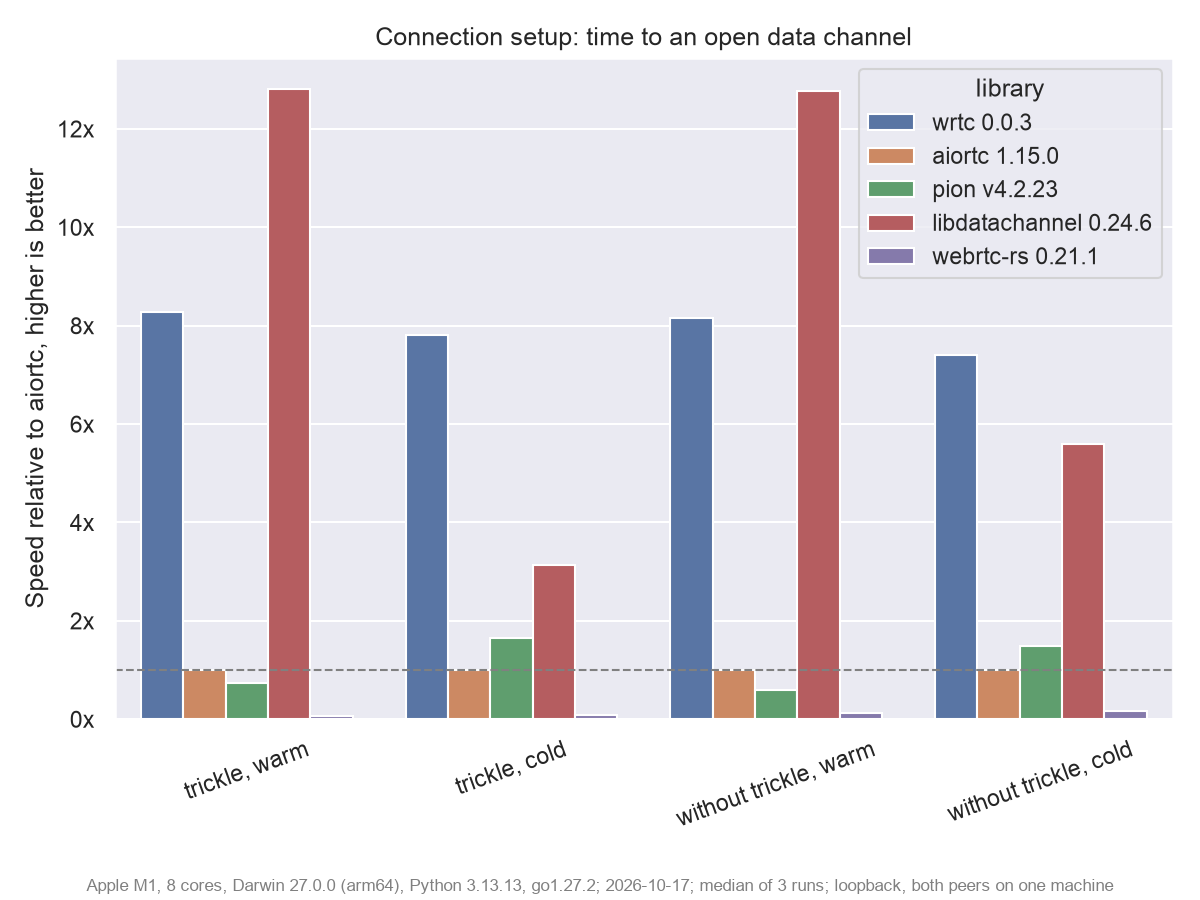
The time from creating a connection to an open data channel: about 3.5 ms, against 29 ms for aiortc. Cold runs start fresh processes. The benchmark keeps the defaults: DTLS 1.3 is on, while SNAP and SPED, the other parts of WARP, are off and would save more round trips.
Data channels
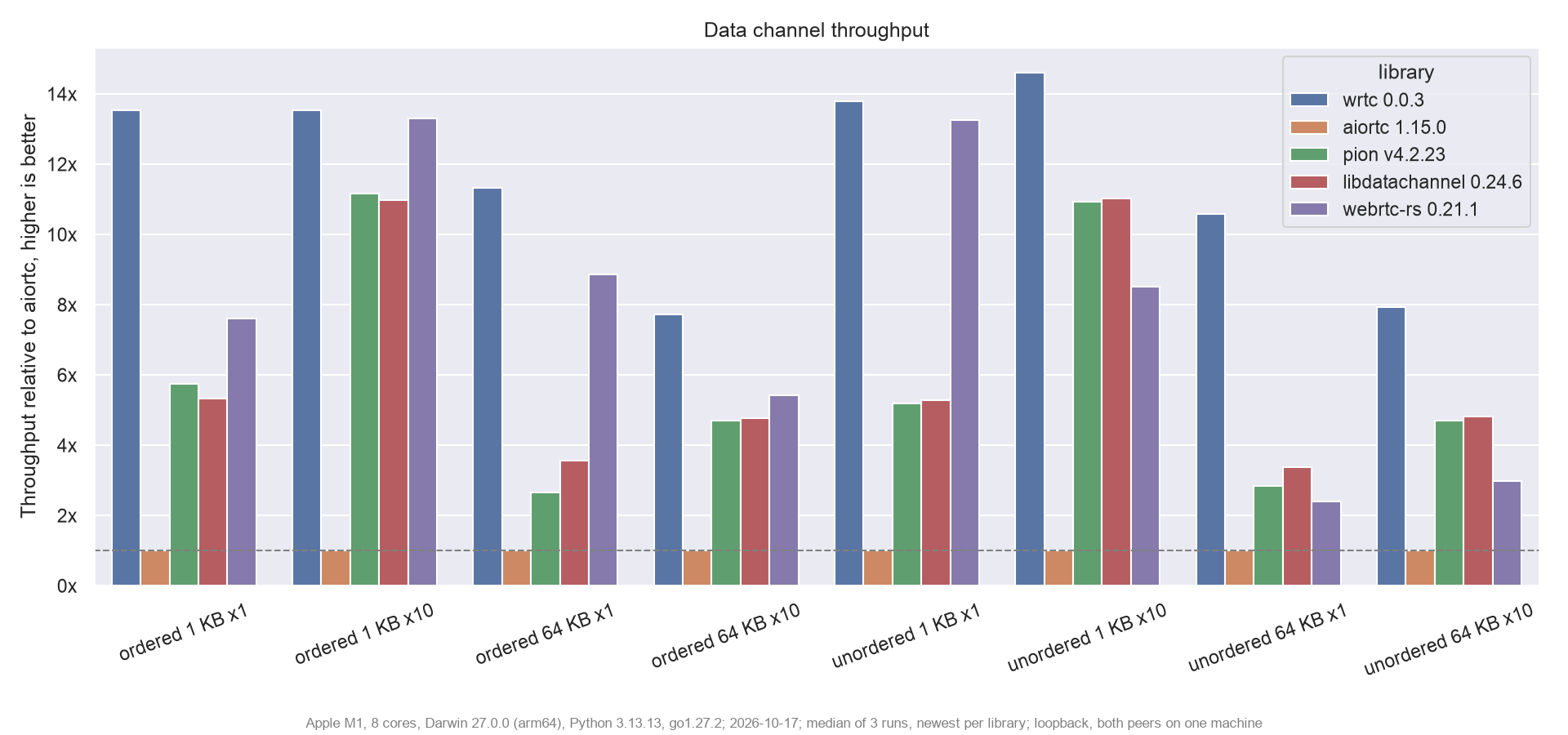
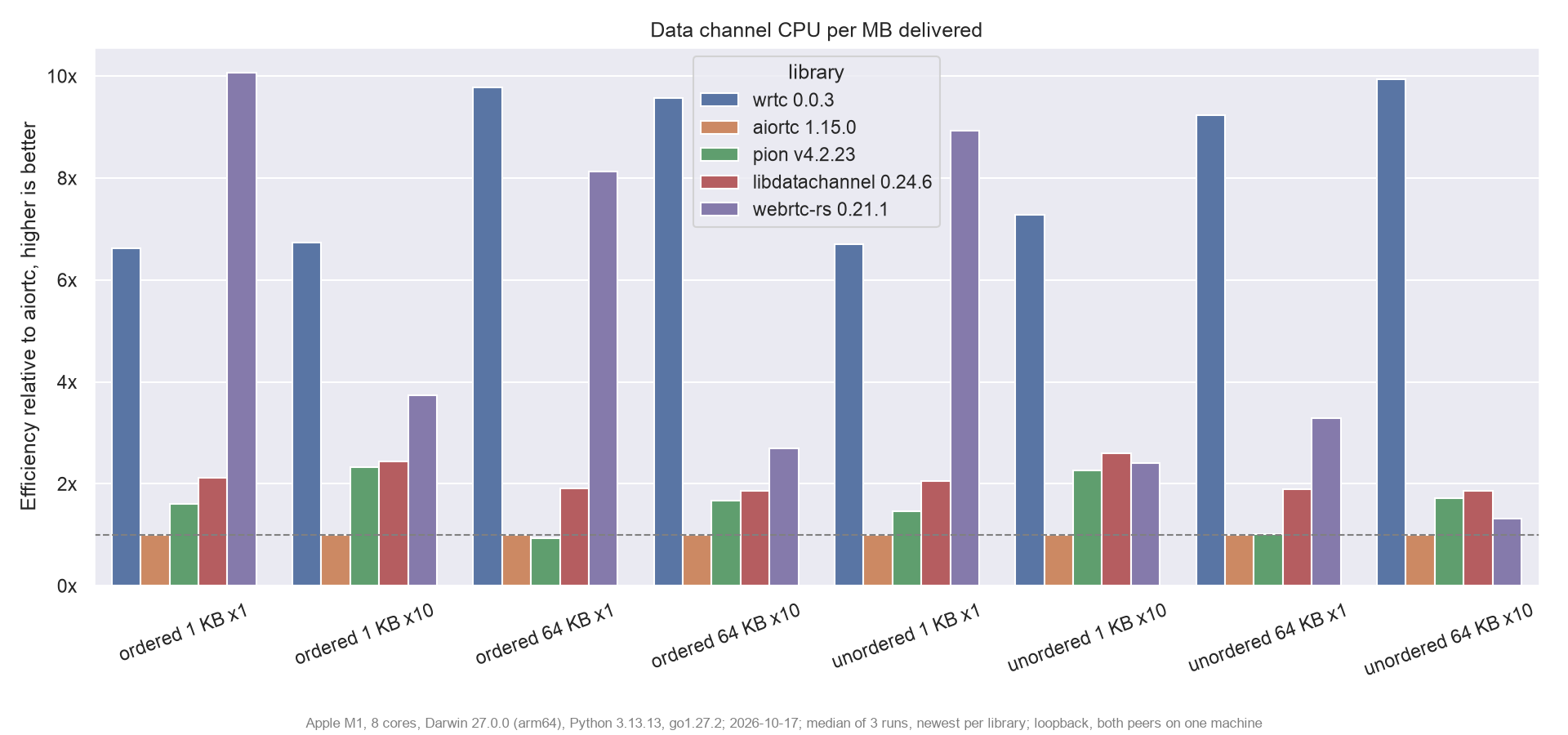
SCTP, DTLS and the network stay in native threads, so Python only sees the messages. That puts Python WebRTC alongside the compiled libraries in throughput rather than near aiortc.
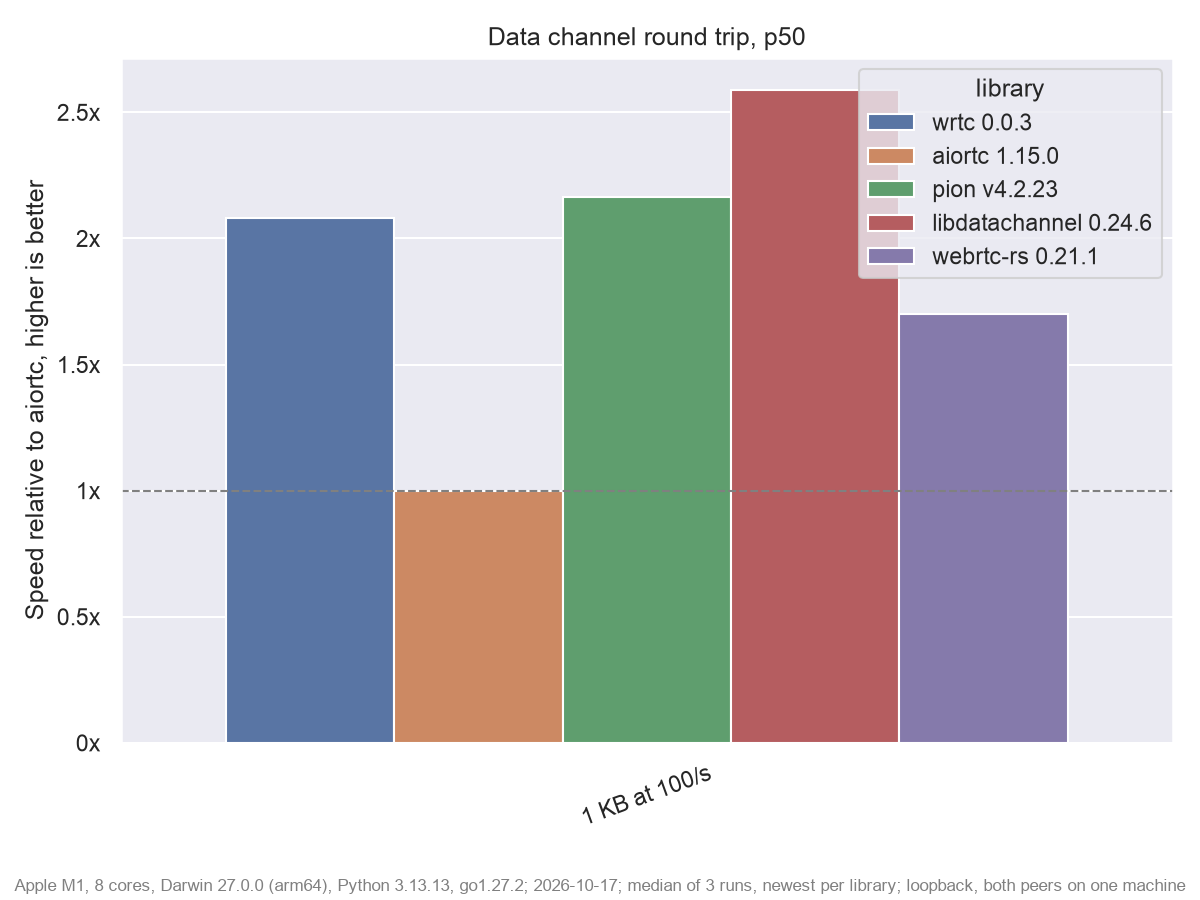
The round trip of 1 KB messages, sent 100 times a second. Every message is handed to your asyncio code, on the event loop, in both directions. The compiled libraries deliver to native code, and aiortc does the whole protocol stack in Python on the loop.
Memory
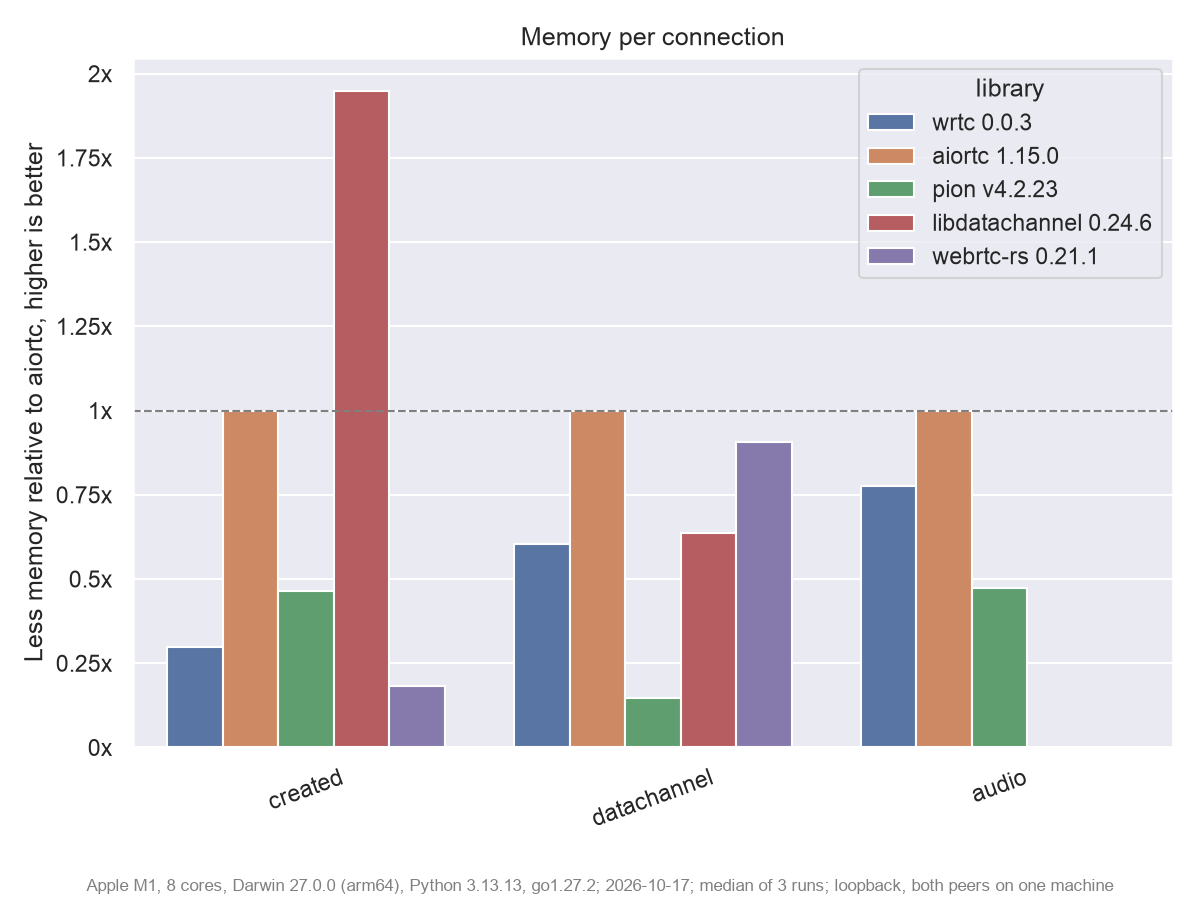
This chart favors aiortc, for two reasons that come from the engine rather than from Python WebRTC’s code:
A bare connection keeps the state of a full browser engine: the codec tables it negotiates with, a congestion controller and its transport. The Python objects on top take under 1 KB.
A connected data channel is mostly ICE: the engine keeps every candidate pair it checked, about 8 KB each, to switch networks without reconnecting. The benchmark Mac has 10 addresses (Wi-Fi, VPN, virtual machine bridges and loopback), each over UDP and TCP, so 50 pairs a connection. aiortc gathers UDP only and skips loopback. In the same test on Linux with one interface, a connected pair takes a third of the memory it takes on that Mac.
Memory stays reserved after connections close, because the allocator keeps it for reuse: opening and closing 100 connections over and over doesn’t grow the process past the first round.
The process itself starts smaller, 92 MB against 128 MB, and holds 1450 connections where aiortc stops at 1100.
Media
Video receive
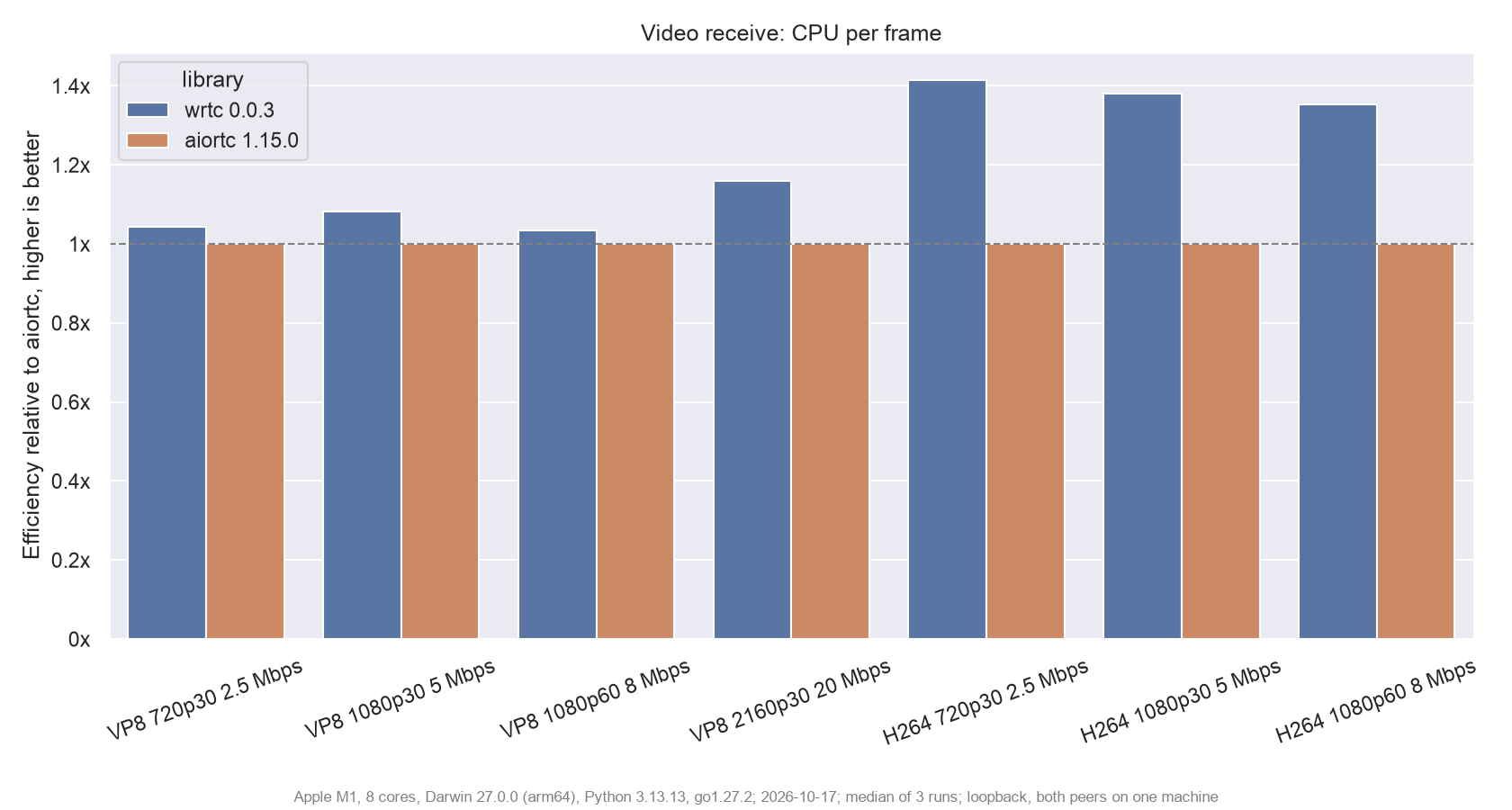
CPU for each frame received, decoded and read in Python. VP8 decodes with the same library in both, so the bars stay close. H.264 is cheaper at every resolution, decoded by VideoToolbox on macOS.
Video send
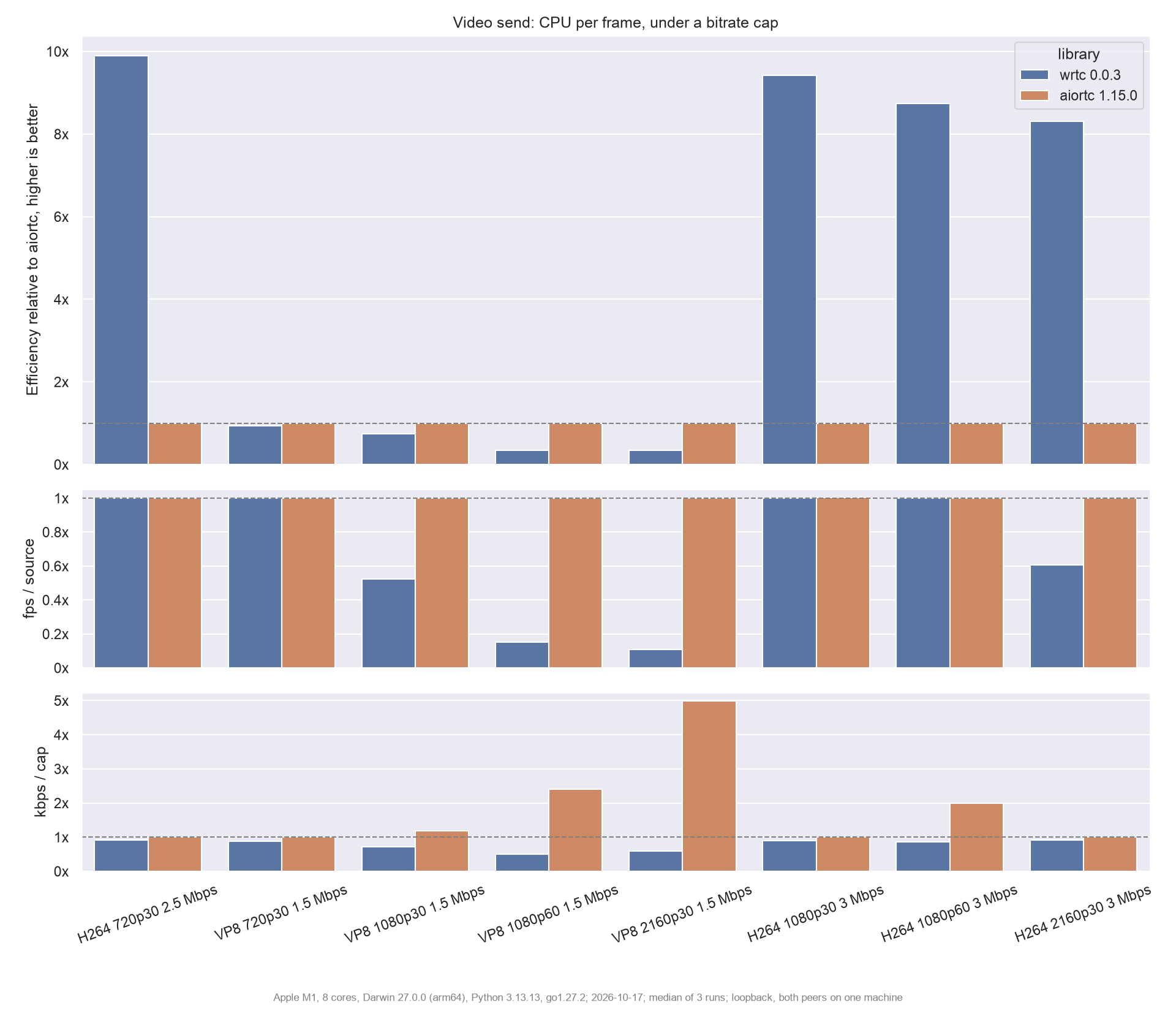
Both libraries send under the same bitrate cap. Read the two panels under the bars before the bars:
Bitrate over the cap. Python WebRTC stays under the cap. aiortc’s VP8 ignores it as the picture grows: twice the cap at 1080p60 and five times at 2160p. Sent to a real network, that is packet loss.
Frame rate over the source. To fit 1080p and 4K into 1.5 Mbps, the engine keeps the resolution and drops frames, as browsers do with that setting. It encodes fewer, much larger frames, so the CPU per frame goes up.
So the VP8 bars compare different work: one library respects the cap, the other doesn’t. H.264 uses the hardware encoder on macOS and costs a tenth of the CPU per frame.
Video call
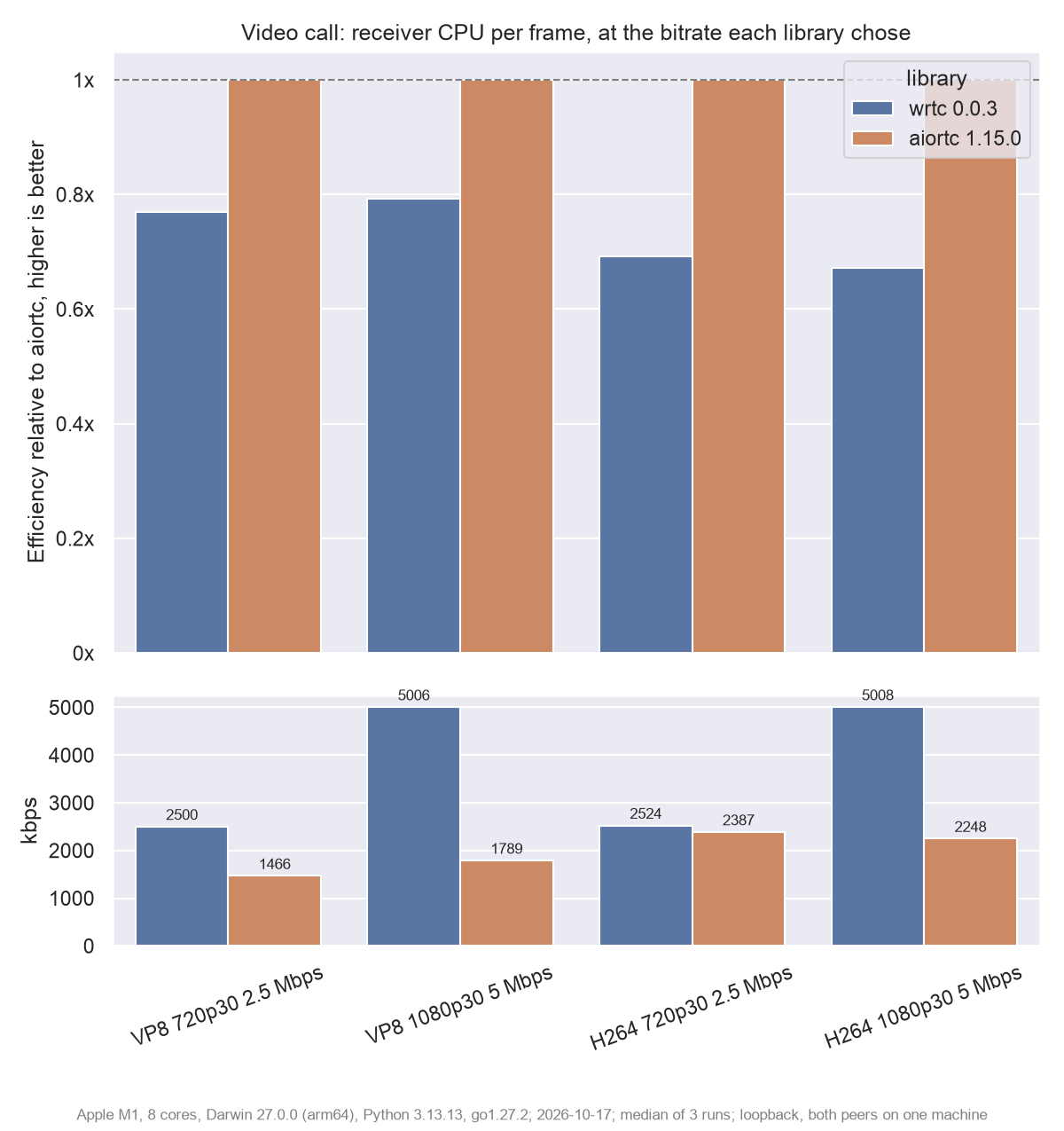
Two peers of the same library call each other, and each library’s congestion control picks the bitrate. Python WebRTC reaches the bitrate the video asks for, 2.5 or 5 Mbps, while aiortc stays near 1.5–2.4 Mbps. The panel under the bars shows it: Python WebRTC receives up to three times the bits for every frame, so a better picture, and decoding more bits costs more CPU per frame.
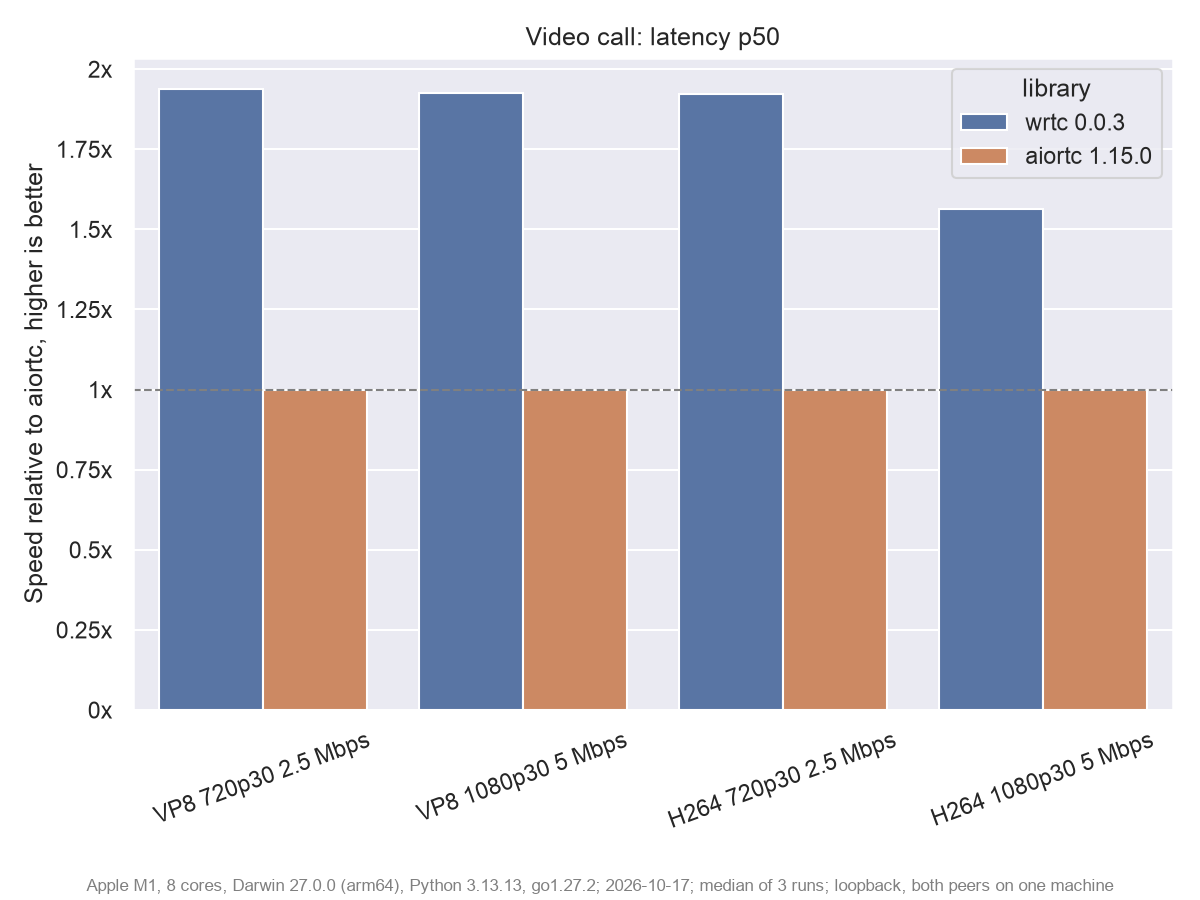
From writing a frame on one side to reading it on the other: 22–28 ms against aiortc’s 44 ms, at the higher bitrate.
Audio
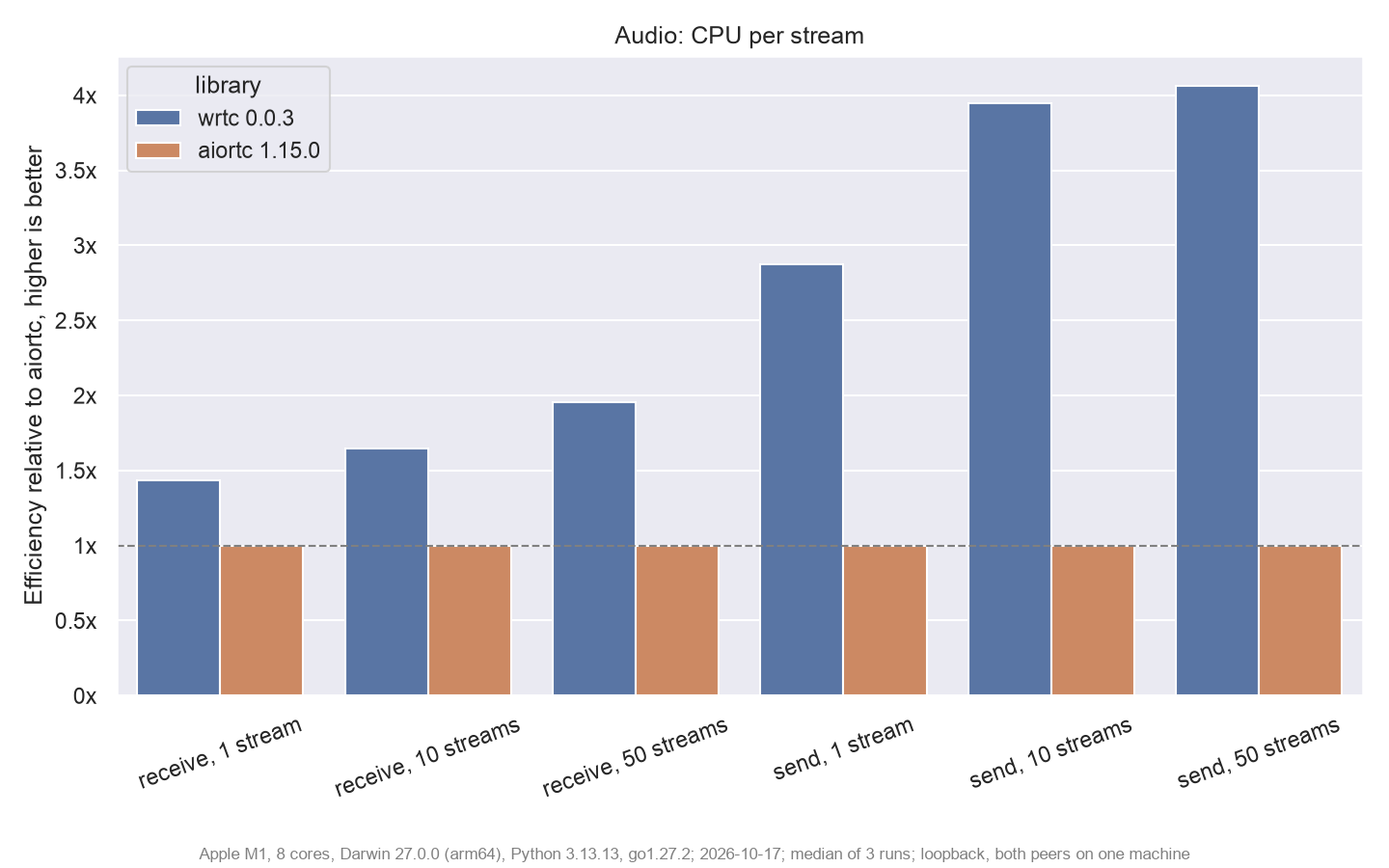
CPU per Opus stream. Packets, encoding and decoding stay native, so the cost per stream drops as streams are added.
Caveats
Both peers run on one machine, so a library that uses more threads competes with its own peer.
aiortc can’t trickle ICE candidates, and can’t cap its encoder: the send caps are aiortc’s own maximum.
Media compares the two Python libraries only. Pion is the peer that sends and receives the encoded files.
The results are of one machine. Run
benchmarks/run.shon yours.